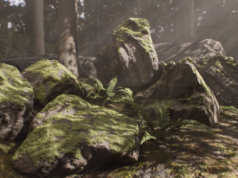



On February 23, Maxon released Redshift 2026.3, a new update focused primarily on quality-of-life improvements and stability enhancements. Rather than introducing major new tools, this release refines existing features and addresses bugs reported in earlier 2026 versions.
Redshift is a GPU-accelerated 3D rendering engine used for visualizing models, animations, and complex production scenes. Below is an overview of the key changes introduced in version 2026.3, along with notable improvements from previous 2026 updates.
Texture Displacement Improvements
Previously introduced in version 2026.2, the texel-density-based displacement system replaced the previous vertex-density approach.
With Redshift 2026.3, this system has been further refined. Smooth mode and “Override Normals” are now enabled by default and can be controlled through the Edge Handling option in the displacement settings. These adjustments help prevent artifacts caused by split normals and improve surface consistency.

Improved Support for Houdini’s Solaris and Copernicus Framework
In addition, this release brings several enhancements to Redshift’s integration with Houdini.
The update adds support for the Geometry Light operator and the Render Statistics panel in Solaris. In addition, interactive performance has been improved within Houdini’s Copernicus image-processing framework, resulting in a more responsive workflow during look development and lighting.

Improved Support for Custom IES Lights

Notable Improvements from Earlier 2026 Versions
Since the initial 2026 release, Redshift has introduced several improvements. As a result, the renderer now offers a more stable and refined workflow.:
- UV Projection Node: Designed to manage post-bake material transformations, this node can be combined with texture displacement and now integrates TriPlanar-style behavior.
- Updated Sun and Sky Model: The lighting model now produces smoother shadows and more accurate low-angle illumination, reducing flickering and banding issues found in earlier versions.
- AMD RX 9000 Series Support: Official support for AMD RX 9000 series GPUs has been added, expanding hardware compatibility.
To find out more, visit the Maxon official site.
– article by G. D’Ambrogio