


How an unexpected career path shaped for Matteo Tagliabue a versatile approach to 3D
Some careers begin with a clear plan. Matteo Tagliabue’s began with a summer walk and a chance conversation that led him to discover a world he had never imagined could become his profession. From that unexpected turning point, 3D became a way of constantly exploring, learning and moving between disciplines rather than fitting into a single defined role.
Today, curiosity remains at the heart of his practice. For Matteo, being a 3D Generalist means staying open to new tools, new challenges and new ways of making things — while accepting that there will always be something you do not know yet. In this Rising Voices conversation, he reflects on the mindset behind that journey, the lessons learned along the way, and why sometimes the most important step is simply deciding to give something a try.

Please introduce yourself and share a bit about your study background with our readers.
My name is Matteo Tagliabue, and I am a 3D Generalist. In simple terms, this means that I work across different stages of 3D production, mainly focusing on modelling, texturing and rendering, but also working with rigging and animation when a project requires it.
I currently collaborate mainly with PlaySys, a software house that develops video games, contributing to several projects related to 3D content production. Alongside this work, I teach Blender and computer graphics, both through online schools and by training people on behalf of companies.
What I enjoy most about my job is that it is never limited to just one field. In addition to video games and teaching, I create product, furniture and environment renders, occasionally work with photogrammetry and 3D printing, sell 3D models online and collaborate on short films and audiovisual productions. I also try to develop some personal projects, especially in the field of animation.
Regarding my educational background, I attended the Computer Graphics master’s programme at BigRock in Veneto. I later continued my training in Milan at Immaginazione Lavoro, where I completed a programme focused on 3D production and animation. These experiences gave me the technical and creative foundations from which my professional journey began.
What was your educational path, and how did it guide you toward your current career?
My journey into 3D began in a fairly unexpected way: during a summer walk with my dachshund, Pepito. I met someone who told me about BigRock and, in a way, that conversation completely changed the direction of my life.
At the time, I was looking for a new educational path. Until then, I had followed several very different directions. In high school, I studied business administration, finance and marketing. I also attended an osteopathy course for a year and later worked in a variety of jobs, without finding something that truly felt like mine.

When I discovered that there was a school dedicated to computer graphics, I saw a real opportunity to turn one of my passions into a career. Since childhood, I had always loved Disney and Pixar animated films and played a lot of video games, but I had never seriously considered that the work behind them could become a profession for me. Once I realised it was possible, I decided almost immediately to give it a try.
I chose BigRock because it seemed like the best place to start from scratch and build a solid foundation. My parents were incredibly supportive, especially at the beginning, and their help allowed me to approach that period with the stability and focus I needed to dedicate myself fully to my studies.
I still remember my time at BigRock as one of the best periods of my life. I was finally studying something I genuinely loved, and I also met many people who are still part of my life today. The master’s programme introduced me to the main stages of 3D production and gave me a broad understanding of how a complete pipeline works. I did not leave already knowing how to do everything perfectly, that would have been slightly too convenient, but I had finally built a strong foundation on which I could continue developing.
After BigRock, I continued studying independently and later enrolled at Immaginazione Lavoro in Milan. I wanted to test what I had learned and understand how the professional world actually worked. It was during this programme that I met some of the people I still collaborate with today, as well as PlaySys, which later became one of my main professional collaborations.
My entire training period was driven by an almost obsessive enthusiasm. Whenever I discovered something new, I wanted to explore it, experiment with it and understand how it worked. The more I learned, the more I realised how much there was still to discover, and that constant curiosity ultimately guided me towards the work I do today.
How did your knowledge of 3D computer graphics influence your studies and how does it impact your work today—whether in design, interiors, or other fields?
Being a 3D Generalist means understanding the main stages of a 3D production pipeline. Of course, this does not mean being equally skilled in every single area. There are tasks in which I feel stronger and others in which I still have a great deal to learn, which I think is completely normal. However, understanding the entire process allows me to see projects more clearly and move between fields that may appear very different but share the same fundamental skills.
One important example is my collaboration with PlaySys. I contribute to the production of content for video games and, as part of this collaboration, I also create 3D models that are sold online. This has made optimisation a major part of my work.
It is not enough for a model to look good: it must also be built correctly, have efficient geometry and suitable textures, and be genuinely usable within a video game or another type of production. People are often taught how to create something, but not always how to make it lightweight, organised and functional. A model can look beautiful, but if the computer struggles simply to open it, there is probably still something that needs to be fixed. This is why optimisation is also one of the subjects I emphasise most during my lessons.

The same knowledge allows me to work across many other fields. I teach Blender through different schools and also train people on behalf of companies. I create renders of interiors, houses, furniture and products, working with designers and other professionals. I also work with photogrammetry and 3D printing, collaborate with LAMP on film productions, and contribute to short films, both by helping other people with their projects and by developing some of my own.
Teaching also has a very positive impact on my professional work. Sometimes I have to revisit subjects that I already know, refresh my memory or find a simpler way to explain them. This prevents me from taking anything for granted and often allows me to understand my own work more deeply. When you have to explain a process clearly to someone else, you quickly discover how well you truly understand it.
Thanks to the practical approach of BigRock and Immaginazione Lavoro, the transition from studying to working professionally felt quite natural. The foundations I built during those programmes are the same ones I still use today, although I continue to update and expand them.
For me, the greatest advantage of 3D computer graphics is precisely this versatility. The fundamental skills remain the same, but I can apply them to a video game, a render, a 3D print, a lesson or a short film. This keeps me from feeling confined to a single profession.
What’s the first project you worked on that gave you a strong sense of accomplishment? Why does it stand out?
Completing a project almost always gives me a great sense of satisfaction. This was true for the first assignments I received, and it is still true today, even with my most recent releases or with projects that may appear relatively small. I still enjoy the moment when something stops being just an idea and becomes a finished piece of work.
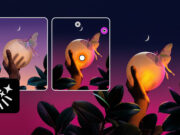
However, the first project I remember with particular affection is a personal piece called Moon House, which I created while continuing to study independently. It was based on a 2D concept by Charlène Le Scanff, and I became determined to recreate it in 3D as faithfully as possible.

It was a small but highly detailed house, with unusual shapes, decorations, painted textures and many wooden elements. I wanted to reproduce every single detail. I sculpted each crack in the wood by hand, modelled the roof tiles one by one and personally recreated some of the patterns used in the textures.
The problem was that, at the time, I still knew very few tools. I was not even aware that certain modifiers existed, such as the Array modifier, which could have saved me a considerable amount of work. As a result, I created almost everything manually, using only the basic knowledge I had at that point. It took me about a month to complete.
Today, after creating many other models, the idea of spending almost an entire month on one small house seems slightly insane. At the time, however, I had managed to achieve something far beyond what I thought I was capable of. The project also won a contest organised by the Instagram page 3D Corner, which naturally made me even more enthusiastic about it.
For quite a while, Moon House became my signature piece. I showed it to practically everyone and was extremely proud of it. Looking at it today, I can clearly see many things I would improve, and I certainly would not consider it one of my strongest projects from a technical perspective. However, it remains one of the most important because it was the first project into which I put all the patience, precision and determination I had.
It showed me that even with limited knowledge, I could achieve something much more ambitious through persistence and a willingness to solve every problem. I probably did not choose the fastest or smartest method, but I completed it, and at the time that gave me an enormous sense of accomplishment.
Which software and tools are your go-to choices, and what makes them indispensable for your work?
The software I use most is Blender. This is not necessarily because I consider it the best software in every possible area: I believe that each program has specific tasks that it handles better than others. What I particularly appreciate about Blender, in addition to its versatility, is the enormous community surrounding it.

Because Blender is free and open source, it has a very active community that constantly develops tools, add-ons and resources, often making them freely available to everyone. This makes the work much easier and also makes the software easier to learn. Especially when I was starting out, whenever I encountered a problem, I knew that someone, somewhere in the world, had probably already faced it, solved it and perhaps even recorded a forty-minute tutorial explaining exactly how.
I mainly use Blender to create models for video games, online marketplaces and rendering projects. In some cases, I also use it to prepare models for 3D printing or for digital sculpting with a graphics tablet. For texturing, I primarily use Substance 3D Painter, while Unreal Engine and Unity allow me to place my models inside video game environments and interactive experiences. For photogrammetry, I often use Polycam on my phone, which I find very practical and reliable.
During my education, I also used Maya, which was the first software I learned to model with, as well as ZBrush, Photoshop, After Effects, Marvelous Designer and Cascadeur. I am currently beginning to explore Substance 3D Designer in greater depth. I do not use all these tools on a daily basis, but understanding how they work helps me adapt to the requirements of different projects.
However, the most difficult part is not simply learning how to use several programs individually. The real challenge is understanding how to make them communicate with one another. Each program uses different formats, settings and export systems. You can know one piece of software extremely well and then become completely stuck when you need to transfer your work into another. This can be especially frustrating at the beginning: you have created everything correctly, but one incorrect export setting suddenly decides to ruin your day.
For this reason, I believe it is important not to depend entirely on a single piece of software. Knowing different tools allows me to choose the most appropriate one for each stage of a project. If one program does not handle a particular task effectively, I know that I can move to another solution. I therefore do not see these programs as competing tools, but as different parts of the same toolbox.
What challenges did you encounter when learning 3D computer graphics, and how did you overcome them?
The greatest challenge I encountered while learning 3D computer graphics was not necessarily a technical one. 3D is an extremely broad field, made up of disciplines that can initially appear almost completely separate from one another. As a result, it is very easy to face a new project and feel that you do not yet have enough knowledge to handle it.
For me, the hardest part was learning to put myself to the test. When a project is different from anything I have previously worked on, doubts immediately arise: perhaps I am not prepared enough, perhaps I do not know how to do it, or perhaps I should wait until I have more experience. The real challenge then becomes being able to say, “All right, I will try.”
Over time, I realised that you rarely feel completely ready before starting something new. Many of the skills you need are developed precisely while working on the project and searching for solutions to the problems that arise along the way.
Technical problems are often the easier part to solve. There are tutorials, documentation, communities and people who have probably already faced a similar issue. You can research, experiment, make mistakes and eventually find a solution. More abstract difficulties, such as insecurity or the fear of not being good enough, are much harder because there is no tutorial that tells you exactly how to deal with them.
The way I learned to overcome them was simply to begin. I had to accept that I would not already know every answer, divide the problem into smaller parts and solve them one at a time. Every completed project makes the next one slightly less intimidating.
I believe that an important part of professional growth is exactly this: not waiting until you feel perfectly ready, but trusting your foundations and your ability to learn what you do not yet know.
Looking back, are there any technical or creative skills you wish you had focused on earlier in your career?
If I had a time machine and could go back, I would probably choose an educational path closer to art or computer science before attending BigRock and Immaginazione Lavoro. Ideally both, although asking for two parallel school lives might be slightly excessive.
My previous education was very different, so I had to develop certain artistic skills later, such as composition, colour theory, and the ability to observe and interpret shapes correctly. These are all skills that I continue to improve, but having an earlier foundation would certainly have helped me.
I also wish I had studied computer science and programming in greater depth. When working with Blender or Unreal Engine, I often use node-based systems and visual scripting tools. Since I do not have a formal background in computer science, I sometimes find it more difficult to think in programming terms, structure a process correctly or create more complex systems.
I know that these skills could simplify my work and further expand what I am able to create. For this reason, I continue to study them gradually. If I could change my educational path, I would therefore choose one that combined art and computer science, two areas that I consider extremely important for working in 3D.
Where do you see your work heading in the next few years? Are any exciting goals or ambitions on the horizon? Any trends or innovations you’re excited about?
Over the next few years, I would like to continue growing professionally by working on increasingly large, complex and ambitious projects. At the same time, one of my main goals is to develop something personal, such as an animated short film or a small independent production based on one of my own ideas.
I would not necessarily want to create it entirely by myself. I would like to involve other artists and professionals, bringing together people with different skills. The original idea and creative direction would come from me, but everyone else’s contribution would make the final result much richer.
Of course, it would be wonderful if a project like this could also reach a wide audience and gain some recognition. First, however, we would have to actually finish it, which is already quite an ambitious part of the plan.
One of the innovations I follow most closely is artificial intelligence, although I have a love-hate relationship with it. I recognise its enormous potential, I already use it in certain parts of my work, and I continue to experiment with it out of personal curiosity as well.
At the same time, I am concerned about its ethical and professional consequences. It can simplify production and open up exciting possibilities, but it may also devalue or replace certain creative roles, perhaps one day even my own. I therefore believe that the real challenge will be learning how to use it without losing the value of human skills, collaboration and the creative decisions behind a project.
What’s one essential lesson your study path has taught you so far, whether about 3D, design, or the creative process in general?
The most important lesson I learned during my education was not to constantly chase perfection. I have to be honest: I did not understand it immediately. I had to learn it the hard way several times before I truly understood what my teachers were trying to tell me.
The pursuit of perfection may seem positive because it comes from the desire to create the best possible work. Very often, however, it slows you down too much or even prevents you from completing a project. You continue changing one detail and then another, until you eventually risk losing sight of the overall result.
An essential skill is therefore understanding when a piece of work can be considered finished. This does not mean settling for less or no longer trying to improve, but recognising the moment when further changes no longer add any real value to the project.
Getting feedback from other people is also essential. When you work on the same project for too long, it becomes difficult to look at it clearly and understand whether there are real problems or whether you simply need to step away from it. A fresh perspective can reveal something you can no longer see or confirm that the work is already complete. Learning to ask for feedback and, above all, to say, “All right, it is finished,” has been one of the most difficult and important lessons of my creative journey.
If you had unlimited resources – time, money, and tools – what would your ultimate professional dream project look like?
If I had unlimited time, money and tools, I would love to create my own production company, involving some of the professionals I have met over the years and whom I consider particularly talented and capable.
I would like to bring together people with different skills and turn some of my ideas into real projects. It could be a production company mainly focused on animated series, short films and feature films, but I would not want to limit it to those areas. I would also like the freedom to explore video games, film productions and other creative projects.
What would excite me most would be seeing an idea in my head take shape through the work of many different people. I would not want an unlimited budget so that I could do everything alone, but so that I could involve talented professionals, combine our abilities and share something we created together with the world.